Volume: the confirmation most beginners ignore
June 24, 2026 · 5 min read
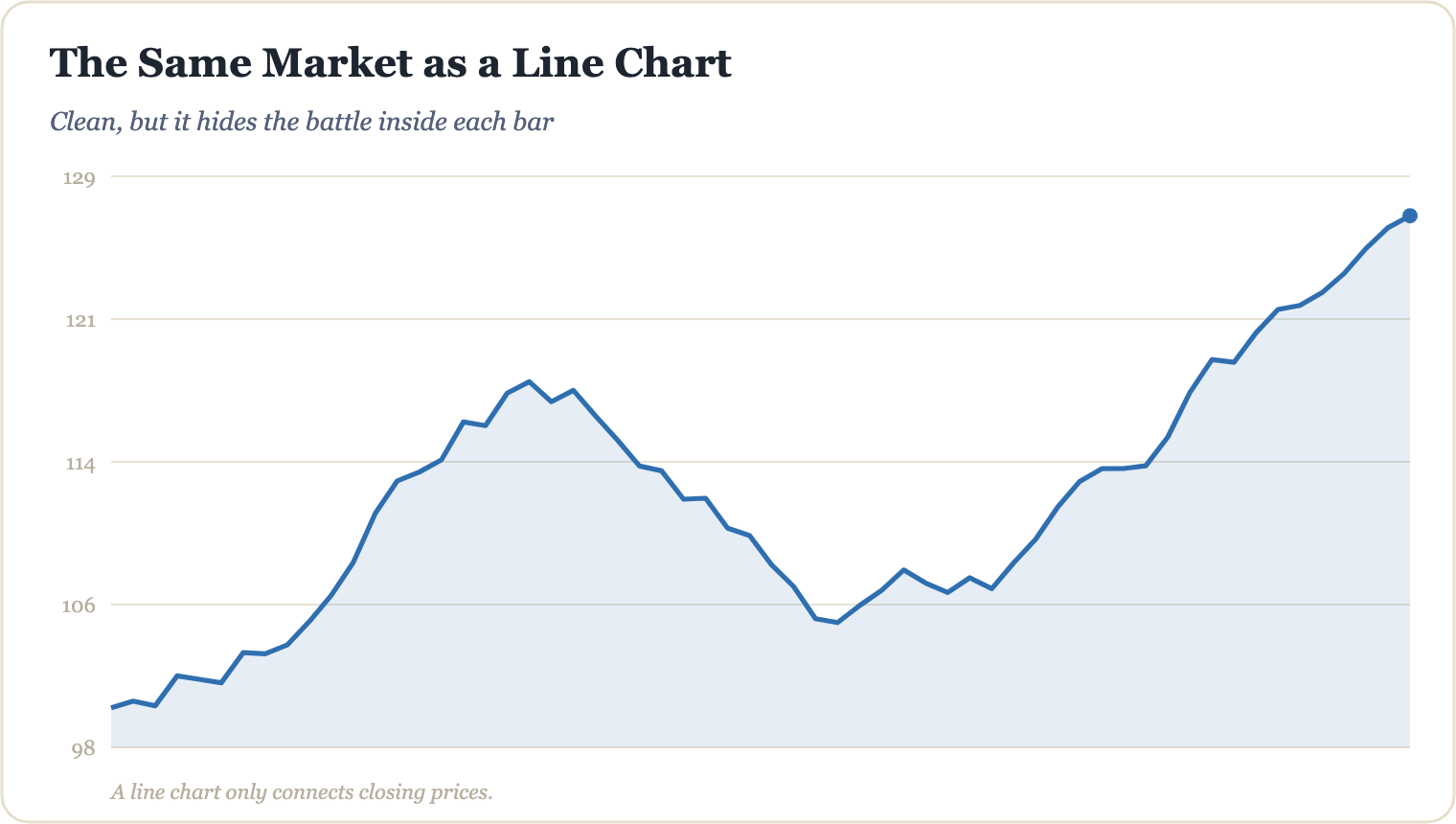
Most beginners spend their first months glued to price charts — watching candles form, drawing support lines, and hunting for the perfect entry pattern. It's understandable. Price is vivid and immediate. But there's a quieter number sitting at the bottom of almost every chart that experienced traders treat as equally important: volume. Ignoring it is one of the most common and costly oversights in beginner technical analysis.
What Volume Actually Tells You
Volume measures the total number of shares, contracts, or units traded during a given period. Think of it as a conviction meter. When a large number of participants are buying or selling, volume is high. When the market is quiet and indecisive, volume is low.
The core principle is simple:
- High volume confirms a move. If a stock breaks above a key resistance level on heavy volume, it suggests real buying interest — many participants are acting on that breakout.
- Low volume questions a move. If that same breakout happens on thin volume, it may be a false breakout — a trap that reverses quickly once the small wave of buyers dries up.
Price alone cannot tell you this. That's the gap volume fills.
Two Classic Volume Scenarios Beginners Miss
1. The High-Volume Breakout
Imagine a stock that has been consolidating between £48 and £52 for three weeks. On Tuesday, it closes at £53.50 — breaking resistance. A beginner sees a breakout and jumps in. But the experienced trader checks volume first. If Tuesday's volume is two to three times the 20-day average, that breakout carries weight. Strong participation suggests institutional buyers — funds, large traders — are involved. That doesn't guarantee the move continues, but it's a meaningful piece of supporting evidence.
2. The Low-Volume Reversal Warning
Now picture a downtrend. The stock has been falling for several days and suddenly prints a green candle that looks like a reversal. Exciting — but if that candle appears on volume well below average, caution is warranted. Weak volume on a potential reversal often means the sellers have simply paused, not retreated. The path of least resistance may still be downward. Risk management — using a sensible stop-loss — becomes especially important in these ambiguous, low-conviction setups.
Volume and the Trend: Reading Them Together
Volume is most powerful when read alongside the prevailing trend, not in isolation. A healthy uptrend typically shows a recognisable pattern:
- Rising price days accompanied by above-average volume — buyers are aggressive and in control.
- Pullback days accompanied by below-average volume — sellers lack conviction; the dip may be a normal pause rather than a trend reversal.
When this pattern flips — when you start seeing heavy volume on down days and light volume on up days inside what looked like an uptrend — it can be an early warning that distribution is taking place. Smart money may be selling into retail enthusiasm.
"Volume is the only indicator that cannot be faked by price action alone. It reflects actual participation, and participation reflects conviction."
A Simple Starting Framework
You don't need complex volume indicators to begin. Start with these practical habits:
- Add a 20-period average volume line to your chart. Most platforms include this as a standard overlay on the volume bars.
- Before acting on any breakout or breakdown, ask: Is volume above or below the 20-day average?
- Treat low-volume moves with extra scepticism and always define your risk — know your stop-loss level before entering any trade.
- Look for volume spikes at key turning points; they often mark climactic buying or selling that precedes a reversal.
Volume analysis is not a crystal ball. No single indicator is. Markets carry inherent risk, and volume simply improves the quality of your questions — it helps you ask "do I have confirmation?" rather than acting on price alone.
Volume is just one layer of a complete trading framework. If you want to explore how it integrates with price action, trend structure, risk management, and modern AI-assisted analysis, the full system is laid out in The Millionaire Trader's AI Playbook — a practical, no-hype guide built for serious learners at every stage.
Go from this article to a complete education.
The Millionaire Trader's AI Playbook — 200+ pages, English & Arabic.
Keep reading
How to Read a Candlestick Chart in 30 Seconds
Candlestick charts look intimidating at first — but once you know what each part means, you can absorb a market's story at a glance. Here's how to do it in 30 seconds flat.
Technical AnalysisThe Anatomy of a Candlestick Wick and What It Reveals
Candlestick wicks are more than just thin lines on a chart — they tell the story of rejected price levels, shifting momentum, and hidden market sentiment. Learn how to read them like a pro.
Technical AnalysisDoji Candles: Spotting Market Indecision
Learn how to read doji candles, understand what market indecision really looks like on a chart, and discover how traders use these signals as part of a broader technical analysis strategy.