The Hammer and Shooting Star Reversal Candles
June 26, 2026 · 5 min read
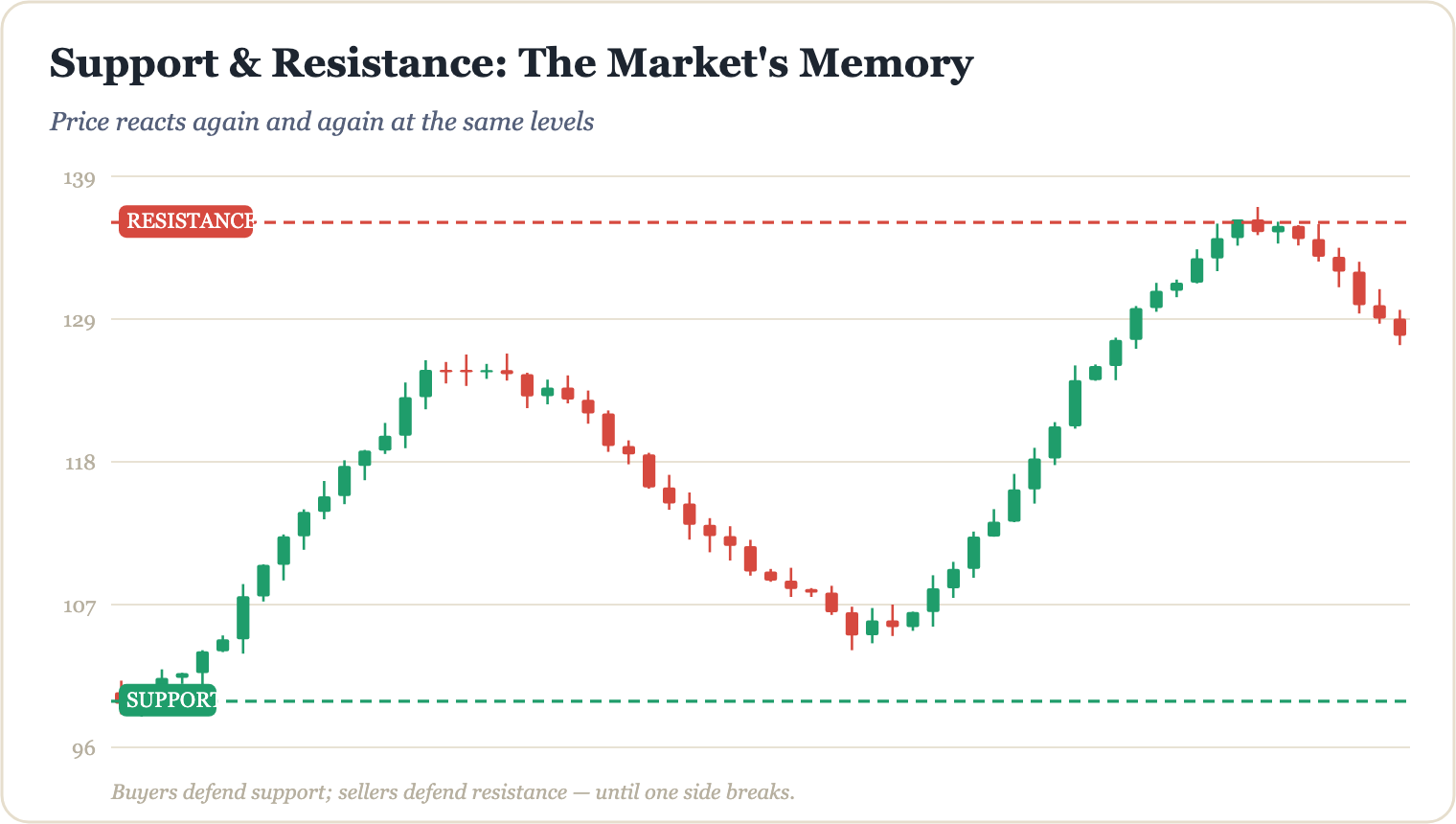
Candlestick patterns are among the most widely used tools in technical analysis, and for good reason — they give traders a visual snapshot of the battle between buyers and sellers within a single price bar. Two of the most recognisable single-candle reversal signals are the hammer and the shooting star. When spotted in the right context, these patterns can offer valuable clues about where price momentum may be shifting — but like all tools in trading, they work best when understood deeply and used with discipline.
What Is a Hammer Candle?
A hammer is a bullish reversal candlestick that appears at the bottom of a downtrend. It has a small real body near the top of the candle and a long lower shadow — typically at least twice the length of the body — with little to no upper shadow. The shape resembles, as the name suggests, a hammer.
The long lower wick tells an important story: sellers pushed price down aggressively during the session, but buyers stepped in with enough force to drive it back up near the open. That rejection of lower prices is what gives the hammer its potential reversal significance.
A Practical Example
Imagine EUR/USD has been trending lower for several sessions and reaches a key support level at 1.0800. On this session, price dips to 1.0760 intraday but closes back at 1.0795. The resulting candle has a tiny body, a long lower tail, and almost no upper wick — a textbook hammer. A trader observing this would note the pattern as a possible sign that selling pressure is exhausting itself. Crucially, confirmation on the next candle — such as a bullish close above the hammer's high — would be required before considering any entry.
What Is a Shooting Star Candle?
The shooting star is essentially the mirror image of the hammer and signals a potential bearish reversal at the top of an uptrend. It features a small real body near the bottom of the candle, a long upper shadow, and little to no lower shadow. The upper wick should be at least twice the length of the body.
The logic is the reverse of the hammer: buyers pushed price sharply higher during the session, but sellers overwhelmed them and forced price back down near the open. This rejection of higher prices hints that bullish momentum may be fading.
A Practical Example
Consider Apple (AAPL) stock rallying into a prior resistance zone around $210. During one session, price surges to $216 intraday but closes at $211 — leaving a long upper wick and a small body. That shooting star, forming right at a known resistance level, catches a technically minded trader's attention. As with the hammer, confirmation matters — a bearish follow-through candle closing below the shooting star's low adds weight to the signal before acting on it.
Key Rules for Trading These Patterns
Understanding the shape of these candles is only half the battle. Context and confirmation are what separate meaningful signals from random noise. Keep these principles in mind:
- Location is everything. A hammer at a major support level carries far more weight than one forming in the middle of a range. The same applies to a shooting star at well-established resistance.
- Wait for confirmation. Never act on a single candle in isolation. Always look for the next candle to confirm the directional shift before entering a trade.
- Volume adds conviction. A hammer or shooting star accompanied by above-average volume suggests stronger participation in the reversal move.
- Always define your risk. A stop-loss below the hammer's low (or above the shooting star's high) is a logical and disciplined placement — but no pattern eliminates risk entirely.
"A candlestick pattern is not a trade signal on its own — it's a question worth asking. The answer comes from the context around it, the confirmation after it, and the risk management you apply to it."
Common Mistakes Beginners Make
One of the most frequent errors new traders make is treating every hammer or shooting star as an automatic entry signal. Markets are noisy, and these patterns can — and do — fail. A hammer in a strongly trending market with no nearby support is far less reliable. Similarly, acting before the candle has fully closed can lead to false reads, since a candle's shape can change dramatically in its final minutes.
Another pitfall is ignoring the broader trend. These are reversal patterns, meaning they are most meaningful when they appear after a sustained directional move. Spotting a hammer after just one down-candle, for example, doesn't carry the same significance as one appearing after a prolonged multi-day decline.
The hammer and shooting star are genuinely powerful additions to any trader's technical toolkit — not because they predict the future, but because they highlight moments where the balance of power between buyers and sellers may be shifting. For those who want to explore how these patterns fit into a complete, rule-based trading framework, the full methodology — including entry triggers, confluence filters, and position sizing — is covered in detail in The Millionaire Trader's AI Playbook.
Go from this article to a complete education.
The Millionaire Trader's AI Playbook — 200+ pages, English & Arabic.
Keep reading
How to Read a Candlestick Chart in 30 Seconds
Candlestick charts look intimidating at first — but once you know what each part means, you can absorb a market's story at a glance. Here's how to do it in 30 seconds flat.
Technical AnalysisThe Anatomy of a Candlestick Wick and What It Reveals
Candlestick wicks are more than just thin lines on a chart — they tell the story of rejected price levels, shifting momentum, and hidden market sentiment. Learn how to read them like a pro.
Technical AnalysisDoji Candles: Spotting Market Indecision
Learn how to read doji candles, understand what market indecision really looks like on a chart, and discover how traders use these signals as part of a broader technical analysis strategy.