Reading Market Structure: Higher Highs and Higher Lows
June 24, 2026 · 5 min read
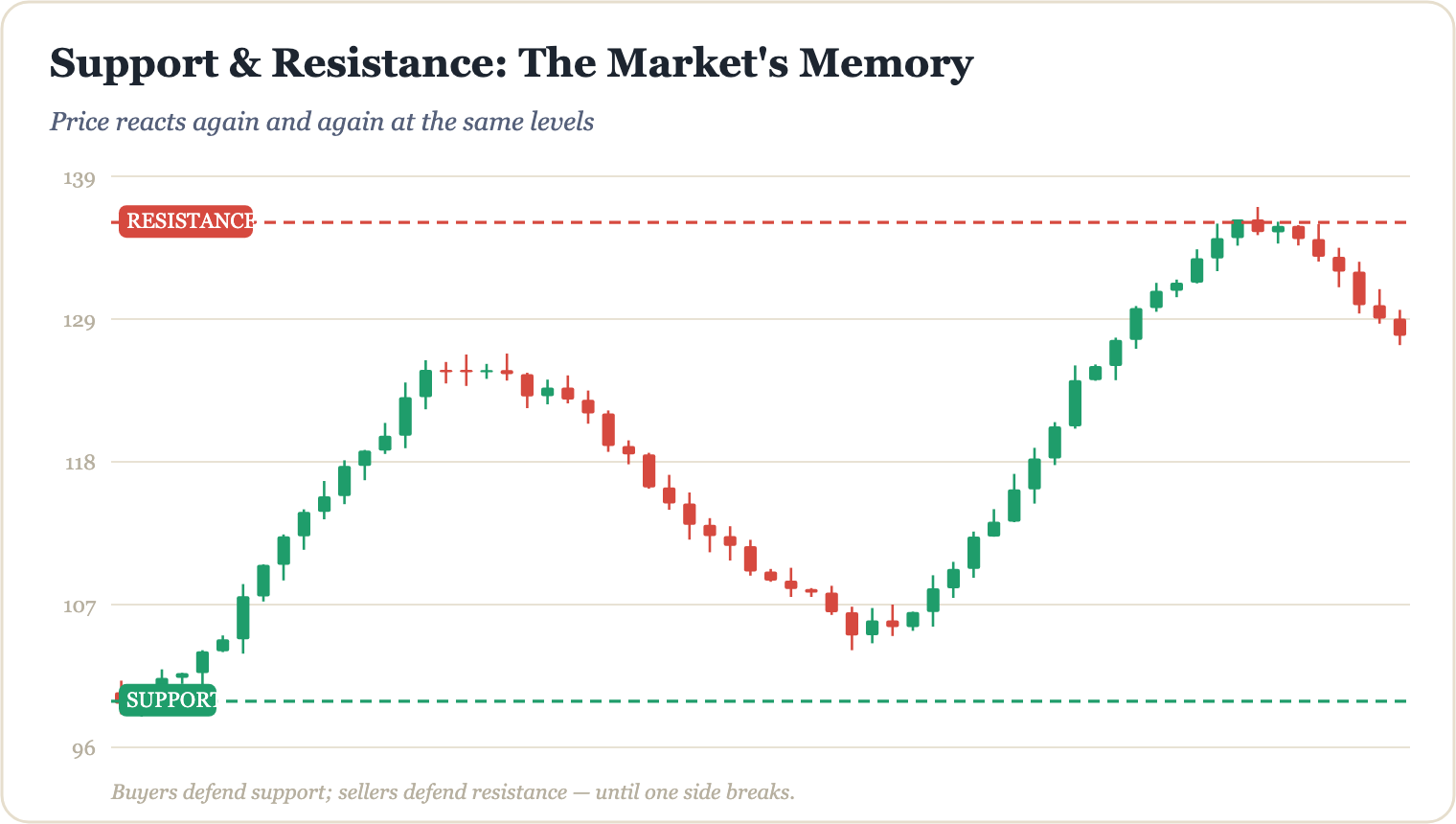
Before you place a single trade, the market is already telling you a story. That story is written in the form of peaks and valleys on a price chart — and learning to read it is one of the most foundational skills in technical analysis. Understanding higher highs (HH) and higher lows (HL) gives you a structured way to determine whether price is trending up, down, or simply moving sideways — and it costs nothing but attention to learn.
What Are Higher Highs and Higher Lows?
Market structure is simply the pattern that price carves out over time. In an uptrend, price consistently makes higher highs — each rally peak surpasses the previous one — and higher lows, meaning each pullback finds support at a level above the prior dip. This sequence signals that buyers are in control: they are willing to step in at progressively higher prices.
The opposite pattern — lower highs (LH) and lower lows (LL) — defines a downtrend, where sellers dominate and price steadily deteriorates. When neither pattern is consistent, the market is ranging, and trend-following strategies carry extra risk.
- Higher High (HH): A price peak that exceeds the most recent previous peak.
- Higher Low (HL): A pullback that holds above the most recent previous trough.
- Lower High (LH): A rally that fails to reach the prior peak — an early warning sign.
- Lower Low (LL): A drop that breaks below the prior trough — confirms downtrend pressure.
A Concrete Example on a Price Chart
Imagine you are watching a daily chart of a major stock index. In January, price peaks at 4,200 (Point A) then pulls back to 4,050 (Point B). In February, price rallies again, this time reaching 4,350 (Point C) — a higher high above Point A. It then retraces to 4,150 (Point D) — a higher low above Point B. This HH–HL sequence is your first structural evidence of an uptrend.
A trader watching this pattern would note that as long as each new pullback holds above the previous low, the bullish structure remains intact. The moment price breaks below a prior higher low — say it drops under 4,150 at Point D — the structure is broken, and caution is warranted. That break does not guarantee a reversal, but it does mean the trend's internal logic has been challenged.
"Price action doesn't lie — but it does demand patience. Structure only becomes visible in hindsight, so always wait for confirmation before acting on what you think you see."
Why Market Structure Matters for Risk Management
Reading HH and HL patterns is not just about identifying direction — it is directly useful for managing risk on every trade. Many traders use the most recent higher low as a logical stop-loss reference. If price is making HH and HL, a long trade placed near a higher low can be exited with a defined, structured stop just beneath that swing point.
For example, if you enter a long position as price bounces from the higher low at 4,150, placing a stop-loss just below that level (say 4,120) gives your trade a clear invalidation point. You are not guessing — the market's own structure is defining your risk. This is far more disciplined than placing stops based on arbitrary dollar amounts or percentages alone.
It is important to remember: no structural pattern removes risk entirely. False breakouts occur, and what looks like a clean uptrend can reverse without warning. Always size positions appropriately and never risk more than you can afford to lose.
Combining Structure With Other Tools
Market structure works best as a filter, not a standalone signal. Traders often combine HH/HL analysis with:
- Moving averages — to confirm the broader trend direction aligns with structure.
- Volume analysis — rising volume on the HH and declining volume on the HL strengthens the case for trend continuation.
- Support and resistance levels — higher lows that form near known support zones carry extra significance.
- Momentum indicators — tools like RSI can flag when a trend is losing steam even before structure breaks.
Using structure in combination with these tools builds a more complete picture and helps you avoid acting on incomplete information — a habit that protects your capital over time.
Mastering higher highs and higher lows is just the beginning of reading price action with clarity and confidence. If you want to see how market structure fits into a full, systematic trading framework — from entry logic to position sizing to trade management — everything is laid out step by step inside The Millionaire Trader's AI Playbook, where structure-based thinking is at the core of every strategy covered.
Go from this article to a complete education.
The Millionaire Trader's AI Playbook — 200+ pages, English & Arabic.
Keep reading
How to Read a Candlestick Chart in 30 Seconds
Candlestick charts look intimidating at first — but once you know what each part means, you can absorb a market's story at a glance. Here's how to do it in 30 seconds flat.
Technical AnalysisThe Anatomy of a Candlestick Wick and What It Reveals
Candlestick wicks are more than just thin lines on a chart — they tell the story of rejected price levels, shifting momentum, and hidden market sentiment. Learn how to read them like a pro.
Technical AnalysisDoji Candles: Spotting Market Indecision
Learn how to read doji candles, understand what market indecision really looks like on a chart, and discover how traders use these signals as part of a broader technical analysis strategy.