Multi-Timeframe Analysis: Top-Down Trading Explained
June 25, 2026 · 5 min read
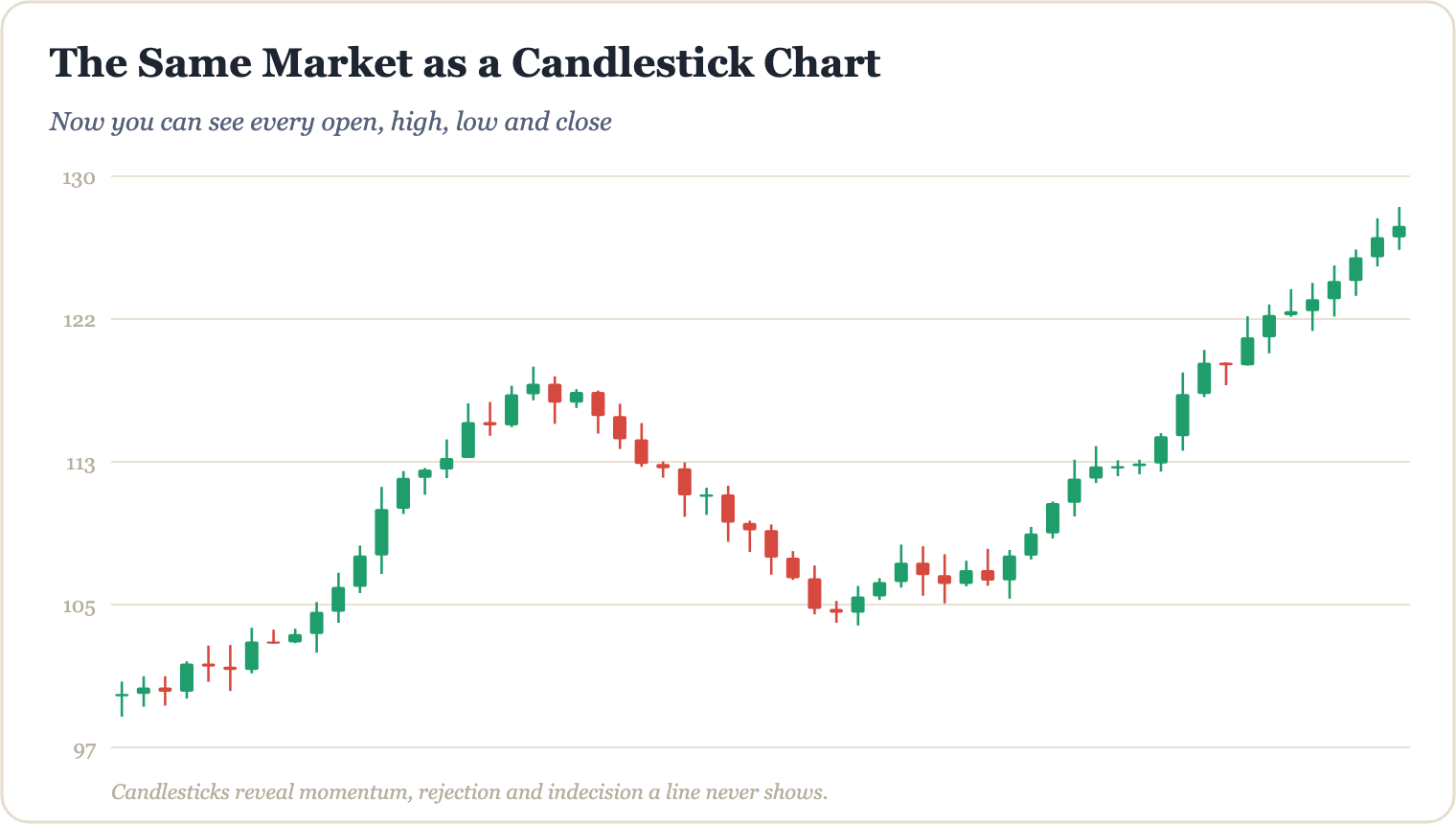
One of the most common mistakes beginner traders make is staring at a single chart — say, a 5-minute candlestick view — and making decisions in complete isolation from what the broader market is doing. Multi-timeframe analysis, often called top-down trading, solves this problem by teaching you to read the market at multiple levels before committing to any trade. It won't eliminate risk, but it can significantly improve the context behind your decisions.
What Is Top-Down Trading?
Top-down trading means you start your analysis on a higher timeframe — such as the weekly or daily chart — to identify the dominant trend and key structural levels. You then work your way down through intermediate timeframes (like the 4-hour or 1-hour chart) before finally zooming into a lower timeframe (such as the 15-minute chart) to look for a precise entry signal. Think of it like zooming out on a map before navigating a single street.
A simple framework many traders use follows three layers:
- High timeframe (HTF): Weekly or Daily — defines the trend direction and major support/resistance zones.
- Intermediate timeframe (ITF): 4-Hour or 1-Hour — confirms momentum and identifies the current swing structure.
- Low timeframe (LTF): 15-Minute or 5-Minute — pinpoints entries, stop-loss placement, and risk management levels.
A Concrete Example: Trading EUR/USD Top-Down
Let's walk through a practical scenario. Suppose you're analysing EUR/USD on a Monday morning.
- Daily chart: Price has been making higher highs and higher lows for three weeks. A clear uptrend. You identify a key daily support zone around 1.0820.
- 4-Hour chart: Price pulled back to the 1.0820 area and is now showing signs of bullish momentum — the most recent 4H candle closed strongly above a short-term resistance level.
- 15-Minute chart: You spot a bullish engulfing candle forming right at the 1.0820 zone during the London session open. This becomes your entry trigger.
Because all three timeframes are aligned — the trend is up on the daily, momentum is returning on the 4H, and a trigger has appeared on the 15M — you have a higher-confluence setup. That said, confluence never guarantees success. Markets can reverse unexpectedly, and every trade should be sized with risk management in mind, typically risking no more than 1–2% of your account capital per trade.
"The higher timeframe tells you where you are in the market. The lower timeframe tells you when to act. Never confuse the two."
Common Pitfalls to Avoid
Multi-timeframe analysis sounds straightforward, but there are several traps that catch traders out repeatedly:
- Timeframe conflict: Looking for a buy on the 15-minute chart while the daily chart is in a clear downtrend is a recipe for fighting the dominant flow. Always respect the HTF bias.
- Over-analysis paralysis: Adding too many timeframes (e.g., trying to align 6 different charts) creates confusion rather than clarity. Three timeframes is usually sufficient.
- Ignoring the entry timeframe's risk: Even with a perfect higher-timeframe setup, if your stop-loss on the entry chart is poorly placed — too tight or too wide — your risk-to-reward ratio breaks down entirely.
How to Choose Your Timeframe Combination
Your ideal timeframe stack depends on your trading style. Swing traders who hold positions for days might use the Weekly → Daily → 4-Hour combination. Intraday traders typically prefer Daily → 1-Hour → 15-Minute. The key principle is that each lower timeframe should be roughly four to six times smaller than the one above it, giving each layer a meaningfully different perspective rather than redundant information.
Building the Habit
The most effective way to internalise top-down analysis is through deliberate, consistent practice. Before every session, start your chart review on the highest timeframe and work downward — never the other way around. Keep a simple trading journal noting what each timeframe told you and whether they were aligned. Over time, reading market structure across multiple timeframes becomes second nature, and your decision-making process becomes far more structured and disciplined.
Multi-timeframe analysis is just one piece of a complete, rules-based trading system. If you want to explore how it integrates with entry models, position sizing, risk frameworks, and AI-assisted pattern recognition, the full methodology is laid out step by step in The Millionaire Trader's AI Playbook — a comprehensive guide built for traders who are serious about learning the craft the right way.
Go from this article to a complete education.
The Millionaire Trader's AI Playbook — 200+ pages, English & Arabic.
Keep reading
How to Read a Candlestick Chart in 30 Seconds
Candlestick charts look intimidating at first — but once you know what each part means, you can absorb a market's story at a glance. Here's how to do it in 30 seconds flat.
Technical AnalysisThe Anatomy of a Candlestick Wick and What It Reveals
Candlestick wicks are more than just thin lines on a chart — they tell the story of rejected price levels, shifting momentum, and hidden market sentiment. Learn how to read them like a pro.
Technical AnalysisDoji Candles: Spotting Market Indecision
Learn how to read doji candles, understand what market indecision really looks like on a chart, and discover how traders use these signals as part of a broader technical analysis strategy.