Bullish and Bearish Engulfing Patterns Explained
June 26, 2026 · 5 min read
Candlestick patterns are one of the oldest tools in a trader's arsenal, and among the most widely studied are engulfing patterns. These two-candle formations appear on virtually every chart and every timeframe, offering a visual snapshot of a sharp shift in market sentiment. Understanding what they mean — and, crucially, what they don't guarantee — is an essential step for any serious student of technical analysis.
What Are Engulfing Patterns?
An engulfing pattern is a two-candle formation where the second candle's real body completely "engulfs" the real body of the first candle. The real body is the area between the open and close price — not the wicks. There are two varieties:
- Bullish Engulfing: A smaller bearish (red/black) candle is followed by a larger bullish (green/white) candle that fully covers the prior candle's body. This suggests buyers stepped in aggressively, overpowering sellers.
- Bearish Engulfing: A smaller bullish candle is followed by a larger bearish candle that fully engulfs it. This indicates sellers took control, pushing price down well beyond the prior session's range.
Neither pattern is a crystal ball. They are signals of potential momentum shifts, not confirmed reversals, and should always be read within context.
Bullish Engulfing: A Concrete Example
Imagine a stock has been sliding lower for five sessions, closing weaker each day. On the sixth day, it opens slightly lower than the previous close — but by the end of the session, buyers have driven price up sharply, closing well above the previous day's open. The sixth candle's body completely swallows the fifth candle's body. That is a textbook bullish engulfing pattern.
Traders watching this setup might look for additional confirmation before acting — for example:
- The pattern forming near a known support level or a previous area of demand
- An increase in volume on the engulfing candle, suggesting conviction behind the move
- A corroborating signal from a momentum indicator such as RSI showing oversold conditions
Without confluence, an engulfing candle is just one data point. With confluence, it becomes a much more meaningful piece of evidence.
Bearish Engulfing: Reading the Sellers' Move
Now picture the opposite scenario. A currency pair has been climbing steadily, and price reaches a zone where it has reversed before — a known resistance level. After a modest bullish session, the next candle opens above the prior close but sellers flood the market, driving price down aggressively. The session closes below the prior candle's open, fully engulfing it in red. This is a bearish engulfing pattern in action.
"A single candle tells you what happened. The candle before it tells you why it matters."
Just as with the bullish version, context is everything. A bearish engulfing pattern appearing in the middle of a range carries far less weight than one forming right at a multi-week resistance ceiling. Traders using this signal must also account for the broader trend — a bearish engulfing candle in a strong uptrend may simply be a pause, not a reversal.
Key Limitations and Risk Considerations
Engulfing patterns are powerful starting points for analysis, but they come with real limitations every learner should understand:
- False signals are common. Markets can produce a clean engulfing candle and then continue in the original direction. No pattern works 100% of the time.
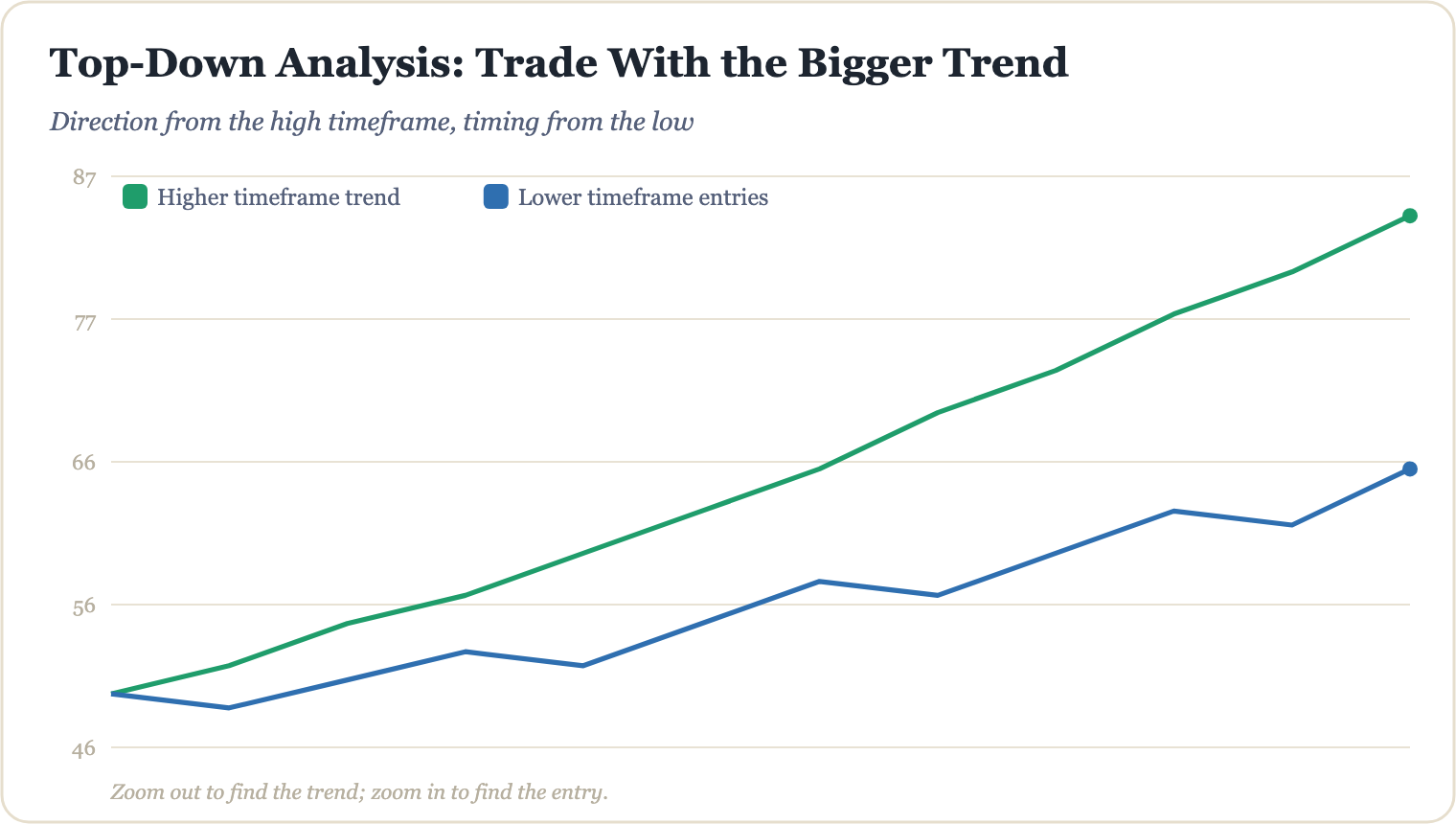
- Timeframe matters. An engulfing pattern on a 5-minute chart carries far less statistical significance than one on a daily or weekly chart.
- Risk management is non-negotiable. Traders typically place a stop-loss beyond the high or low of the engulfing formation to define and limit potential losses before entering a trade.
- Confirmation reduces — but never eliminates — risk. Waiting for the next candle to confirm direction, or combining the pattern with other indicators, improves the quality of the signal.
Treating any single candlestick pattern as a standalone trading system is a common beginner mistake. Engulfing patterns work best as one component within a structured, rules-based approach that includes trend analysis, support and resistance, volume, and strict position sizing.
If you want to explore how engulfing patterns fit inside a complete, step-by-step trading framework — including how to combine them with indicators, screeners, and risk models — everything is covered in depth inside The Millionaire Trader's AI Playbook, where these concepts are built into a full system designed to help you trade with clarity and discipline.
Go from this article to a complete education.
The Millionaire Trader's AI Playbook — 200+ pages, English & Arabic.
Keep reading
How to Read a Candlestick Chart in 30 Seconds
Candlestick charts look intimidating at first — but once you know what each part means, you can absorb a market's story at a glance. Here's how to do it in 30 seconds flat.
Technical AnalysisThe Anatomy of a Candlestick Wick and What It Reveals
Candlestick wicks are more than just thin lines on a chart — they tell the story of rejected price levels, shifting momentum, and hidden market sentiment. Learn how to read them like a pro.
Technical AnalysisDoji Candles: Spotting Market Indecision
Learn how to read doji candles, understand what market indecision really looks like on a chart, and discover how traders use these signals as part of a broader technical analysis strategy.